


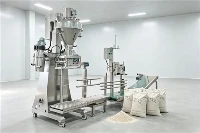

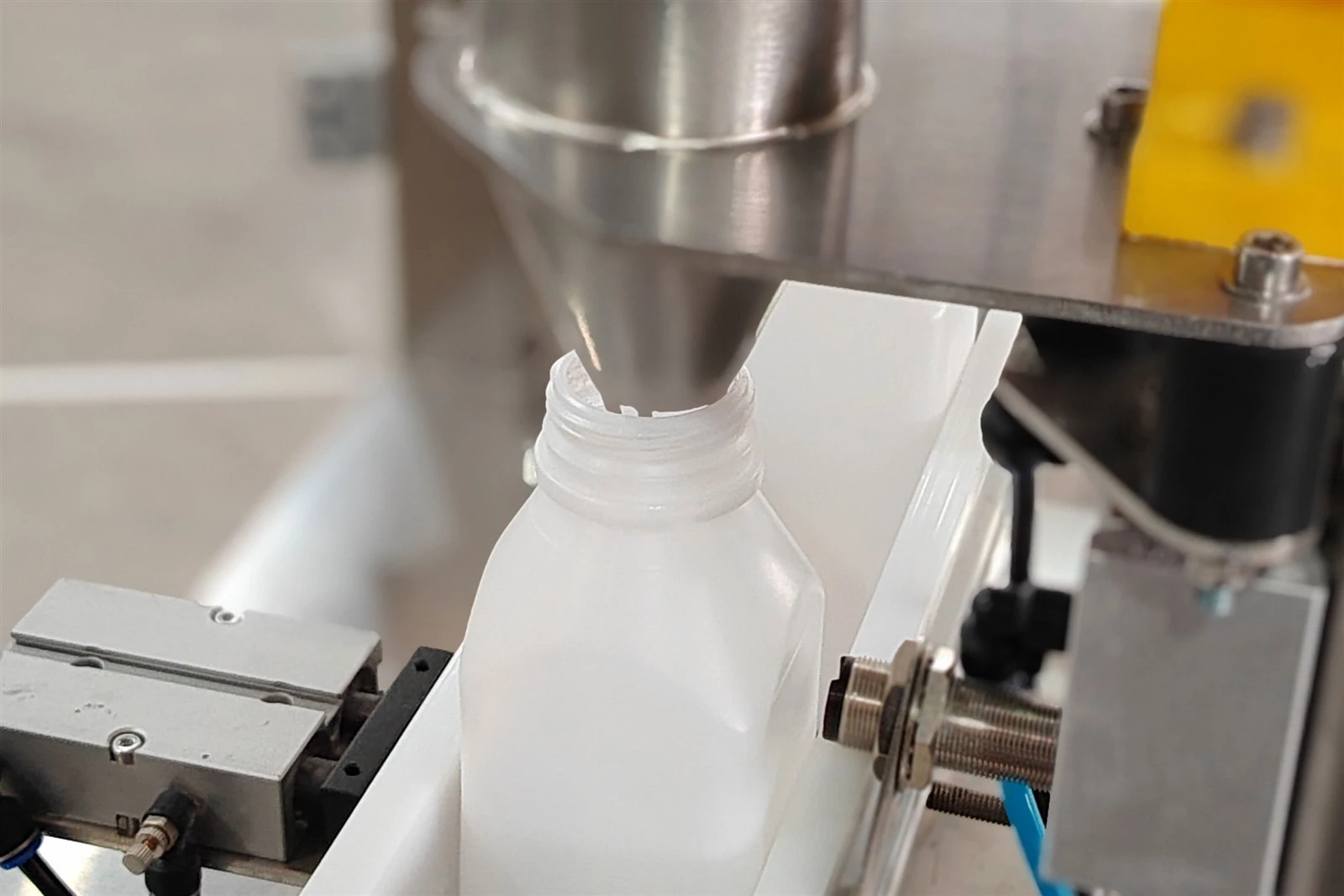
Dust generation is a common challenge in industrial powder filling operations. Fine powders can become airborne during feeding, dosing, filling, cleaning, and product changeover. Excessive dust can lead to product loss, additional cleaning work, equipment contamination, and potential occupational exposure.
The amount of dust generated depends heavily on the characteristics of the powder and the way it is handled. Particle size, bulk density, cohesion, moisture, filling speed, transfer distance, and equipment design can all influence dust generation.
Reducing dust therefore requires more than adding an extraction fan to a filling machine. The most effective approach is to control dust at the point where it is generated while keeping the powder transfer process stable and enclosed as much as practical.
Why Does Powder Filling Generate Dust?
Powder can become airborne when material falls from one location to another, enters a container, or is disturbed by mechanical movement.
During filling, powder entering a bag or container displaces the air already inside that package. If the powder falls from a significant height, the resulting airflow can carry fine particles out of the container. HSE guidance on local exhaust ventilation specifically identifies powder and granular material entering containers as a dust-generation mechanism and recommends measures such as reducing fall distance, partially enclosing the process, and minimizing the open area of the container.
Dust can also be generated during powder transfer into the filling machine, particularly when operators manually empty bags or sacks into a hopper.
Other sources include powder buildup around the filling nozzle, leaking connections, material spillage, and cleaning operations.
The first step toward reducing dust is therefore to identify exactly where airborne powder is being generated.
Keep Powder Transfer as Enclosed as Practical
One of the most effective ways to control powder dust is to prevent it from escaping into the surrounding workplace.
An enclosed material transfer system can reduce the amount of powder exposed to open air during feeding and conveying. HSE guidance recommends enclosing processes and using closed transfer and handling systems where practical, while minimizing manual handling of materials.
For a powder filling line, this can mean using enclosed hoppers, covered conveyors, enclosed screw feeders, or other controlled transfer equipment.
The exact configuration depends on the product and production layout. Not every powder filling application requires a completely enclosed system, but unnecessary open transfer points should be avoided where practical.
Reduce the Distance Powder Falls During Filling
The distance between the filling outlet and the product inside the package can influence dust generation.
When powder falls through a greater distance, it can entrain air and create additional turbulence as it enters the container. HSE's LEV guidance specifically identifies reducing the fall distance as one control for dust generated during powder transfer into containers.
For some applications, the filling nozzle can therefore be positioned closer to the package or adjusted during filling.
This is particularly relevant for fine powders that are easily dispersed.
The correct position depends on the powder, package dimensions, filling mechanism, and machine structure. Simply moving the nozzle closer is not always sufficient if the powder is highly cohesive or the container itself creates strong air displacement.
Control Filling Speed
Higher filling speed can improve production capacity, but it may also increase dust generation for some powders.
A high material flow rate can create greater turbulence during discharge and may release more fine particles into the surrounding air.
The practical solution is not necessarily to operate the machine as slowly as possible. Instead, the filling speed should be matched to the powder characteristics and required production rate.
For a particular powder, there may be a stable operating range where the machine achieves the required output without generating unnecessary dust.
Testing the actual product is the most reliable way to determine this range.
Use the Right Filling Mechanism
The filling mechanism can affect how powder is transferred into the package.
Auger filling is commonly used for powder applications because the rotating screw provides controlled material dosing. The auger configuration, screw geometry, rotation speed, hopper design, and powder properties all influence the material flow.
For some powders, a controlled auger discharge can help avoid the uncontrolled dumping of material into the package.
However, the filling mechanism should be selected according to the powder rather than simply assuming that an auger filler will eliminate dust.
Very fine, cohesive, or aerated powders may require additional consideration of hopper design, feeding, discharge configuration, and dust extraction.
Minimize Air Displacement Inside the Package
When powder enters a closed or partially enclosed bag or container, the incoming material occupies volume that was previously occupied by air.
That air needs somewhere to go.
If the air escapes rapidly through the open area of the package, it can carry fine powder particles with it.
This is one reason why the relationship between the filling nozzle and package opening is important.
HSE guidance identifies displacement of air during powder or granular transfer into containers as a dust-generation mechanism and recommends reducing the container's open area and using partial enclosure or a receiving hood where appropriate.
For dusty applications, the filling station can therefore be designed to manage both powder flow and displaced air.
Use Local Exhaust Ventilation at the Source
Local exhaust ventilation (LEV) is an important engineering control when dust cannot be completely prevented.
Instead of relying only on general room ventilation, LEV captures airborne contaminants close to the point where they are generated.
For powder filling, an appropriately designed extraction point may be located around the filling station, hopper, transfer point, or another dust-generating area.
HSE's guidance on LEV emphasizes that effective systems need to be properly designed, installed, commissioned, tested, and maintained. The extraction hood must also be appropriate for the source and direction of the contaminant cloud.
This is important because simply installing a high-capacity fan somewhere in the workshop does not guarantee effective dust capture.
The extraction point needs to be close enough to the source and positioned appropriately for the actual airflow and powder movement.
Avoid Excessive Airflow Around the Filling Area
Dust extraction needs to capture airborne powder without creating unnecessary disturbance to the filling process.
Poorly positioned air movement can interfere with powder discharge or pull material away from the package.
For example, an extraction opening positioned too aggressively near the filling nozzle may disturb the powder stream or remove usable product from the package.
The ventilation system should therefore be designed together with the filling equipment rather than added as an unrelated component.
The objective is to capture airborne dust while keeping the intended product stream stable.
Improve Hopper and Feeding Design
Dust can also originate upstream of the filling nozzle.
Manual dumping of powder bags into an open hopper can create a significant dust release, particularly when the powder is fine and the bags are emptied quickly.
A better approach may involve enclosed feeding, controlled transfer, or a hopper equipped with appropriate extraction.
HSE recommends minimizing manual powder handling and considering automated delivery systems where practical.
The hopper itself should also provide stable powder flow. Bridging, sudden collapse of powder, and irregular feeding can cause bursts of material that increase dust generation.
A stable feeding process is therefore useful for both filling consistency and dust control.
Prevent Powder Spillage Around the Filling Station
Not all powder on the floor comes directly from airborne dust.
Spillage around the filling station can occur when bags or containers are incorrectly positioned, when a package is damaged, or when powder accumulates around the filling nozzle.
Once powder reaches surrounding surfaces, it can later become airborne again through foot traffic, vibration, mechanical movement, or cleaning.
Good equipment design should therefore minimize opportunities for powder to escape from the intended material path.
Container positioning systems, appropriate filling nozzles, guards, and properly sealed transfer points can all help reduce unnecessary spillage.
Keep the Filling Equipment Clean
Powder buildup on machine surfaces can become another source of airborne dust.
If material accumulates around the hopper, filling head, conveyor, or other components, subsequent machine movement may disturb the deposits.
Regular cleaning helps prevent this accumulation.
However, the cleaning method itself is important.
HSE recommends using suitable vacuum cleaning rather than dry sweeping because sweeping can raise settled dust back into the air. It also advises against using compressed air where this would increase exposure by dispersing dust.
Cleaning procedures should therefore be selected according to the powder's properties and the applicable safety requirements.
Inspect Seals, Connections, and Transfer Points
Leaks around equipment connections can release powder continuously, even when the main filling operation appears to be working correctly.
Potential problem areas include:
Hopper connections
Flexible connections
Screw feeder interfaces
Filling nozzles
Dust extraction ducts
Inspection doors
Sealing components
Small leaks can gradually create deposits around the machine.
Regular inspection and maintenance can help identify these problems before they become larger sources of dust.
HSE guidance also emphasizes that seals and joints in powder-handling equipment need appropriate design, inspection, and routine maintenance.
Control Powder Properties Where Possible
Machine design is only part of the dust problem.
The powder itself strongly affects how easily airborne particles are generated.
Very fine powders generally require more careful handling than larger particles or granulated materials. Moisture, cohesion, particle size distribution, and bulk density can also influence flow and dust behavior.
Where the formulation and product requirements allow it, a lower-dust material form may sometimes be considered. HSE guidance notes that using materials in reduced-dust forms such as granules, pellets, pastes, or dedusted powders can be an option when appropriate.
However, this is not always possible for a finished product. In many food, pharmaceutical, chemical, and nutritional applications, the powder form is part of the product specification.
In those cases, the equipment and process should be adapted to the powder rather than trying to change the product unnecessarily.
Consider Dust Characteristics Before Choosing Equipment
Two powders with the same target filling weight may require different equipment configurations.
For example, a relatively free-flowing powder may discharge easily from a hopper, while a cohesive powder may require additional feeding assistance.
A very fine powder may also require more attention to enclosure and dust extraction than a heavier, less dispersible material.
For this reason, manufacturers should provide the equipment supplier with relevant product information before finalizing the filling system.
Useful information may include:
Product type → Bulk density → Particle characteristics → Filling weight → Package type → Production capacity → Dust-control requirements
Where practical, testing the actual powder can provide much better information than selecting equipment based only on a general product name.
Maintain Stable Machine Operation
Unstable machine operation can increase both dust and product loss.
If the filling nozzle moves inconsistently, the container is not positioned correctly, or the dosing system produces irregular bursts of powder, material may escape from the intended filling area.
Sensors, actuators, conveyors, dosing systems, and other components should therefore be maintained so that the filling cycle remains repeatable.
A stable filling process makes dust control easier because the material is moving through a predictable path.
Do Not Rely Only on Personal Protective Equipment
Personal protective equipment may be necessary for certain powder applications, particularly when the product itself presents a health hazard.
However, PPE should not be treated as the primary method of controlling process dust when engineering controls are reasonably practicable.
HSE guidance places emphasis on eliminating or reducing dust at source, enclosing processes, and using effective LEV before relying on respiratory protective equipment.
The appropriate control strategy also depends on the specific powder and its safety information. Manufacturers should review the relevant SDS and carry out an appropriate workplace risk assessment.
How DJ-PACK Can Help With Powder Dust Control
For industrial powder packaging applications, DJ-PACK can configure powder filling equipment according to the characteristics of the product and the required production process.
Depending on the application, a powder packaging system may include controlled feeding, auger dosing, hopper systems, filling nozzles, conveyors, bag handling equipment, and auxiliary dust-control components.
The appropriate configuration depends on the powder, filling weight, package format, production capacity, and required level of containment.
For dusty products, the goal should be to control the material throughout the transfer path rather than relying only on extraction at the final filling point.
Product samples and application information are useful when evaluating the appropriate machine configuration because powder behavior can vary significantly between products.
Final Thoughts
Reducing dust during powder filling operations requires a combination of product control, equipment design, process control, and maintenance.
The most effective starting points are to keep powder transfer enclosed where practical, reduce unnecessary fall distance, control filling speed, stabilize feeding, manage displaced air, and capture airborne dust close to its source with appropriately designed local exhaust ventilation.
Good housekeeping is also important because powder that has settled around the machine can become airborne again during cleaning or normal production activity.
For manufacturers planning a new powder filling line, dust control should be considered during equipment design rather than treated as an afterthought.
A well-designed system should control the powder from feeding through dosing and final package handling while minimizing unnecessary release into the surrounding production environment.


