


Powder sachet packing machines are widely used for packaging products such as instant coffee, milk powder, sugar, salt, spices, pharmaceutical powders, nutritional supplements, and chemical powders. These machines typically form small sachets, accurately dose the powder, seal the package, and cut it into individual sachets.
Depending on the product and packaging format, powder sachet machines may use auger dosing, volumetric dosing, or other specialized filling systems. Common package formats include three-side seal sachets, four-side seal sachets, stick packs, and multi-lane sachets.
This article introduces 10 manufacturers that offer powder sachet packing machines, powder dosing systems, or complete small-sachet packaging solutions.
What Is a Powder Sachet Packing Machine?
A powder sachet packing machine is designed to pack powdered products into small, sealed individual packages. The machine normally integrates several operations, including film unwinding, film forming, powder dosing, heat sealing, cutting, and date coding.
Some machines produce one sachet at a time, while multi-lane models can produce several sachets simultaneously. Multi-lane equipment is often used for high-volume products such as sugar, coffee, seasoning, pharmaceutical powders, and dietary supplements.
The suitable machine configuration depends on the powder's flowability, bulk density, dust level, target fill weight, sachet dimensions, sealing material, and required production speed.
Top 10 Powder Sachet Packing Machine Manufacturers
The manufacturers below were selected based on their involvement in powder sachet packaging, stick-pack systems, auger dosing, VFFS or HFFS technology, and related packaging automation.
| No. | Manufacturer | Main Powder Sachet Packaging Capabilities | Official Website |
|---|---|---|---|
| 1 | IMA Group | Pharmaceutical, food, coffee, and powder sachet packaging systems | Official website |
| 2 | Syntegon Technology | Powder stick packs, sachets, and pharmaceutical packaging lines | Official website |
| 3 | DJ-PACK | Powder sachet and stick-pack machines for food, chemical, and pharmaceutical powders | Official website |
| 4 | Universal Pack | Multi-lane sachet machines for powders, liquids, and granules | Official website |
| 5 | PFM Packaging Machinery | Vertical and multi-lane packaging systems for powdered products | Official website |
| 6 | Viking Masek | VFFS and sachet packaging systems with powder filling options | Official website |
| 7 | All-Fill | Auger filling and powder packaging equipment for small packages | Official website |
| 8 | Paxiom / WeighPack Systems | Powder filling and sachet or pouch packaging solutions | Official website |
| 9 | VTOPS | Powder sachet, stick-pack, and auger dosing machinery | Official website |
| 10 | AUGER Enterprise | Powder sachet, stick-pack, and premade pouch packing machines | Official website |
The companies serve different market segments. Some focus on pharmaceutical and high-speed multi-lane sachet systems, while others provide more flexible equipment for food, chemical, and general industrial powder packaging.
1. IMA Group
IMA Group is an Italian packaging machinery manufacturer with extensive experience in pharmaceutical, food, coffee, and consumer product packaging.
IMA's packaging portfolio includes equipment for powder products, single-dose packaging, stick packs, sachets, and other flexible packaging formats. Its pharmaceutical packaging solutions are designed for applications where dosing accuracy, hygiene, traceability, and production consistency are important.
For powder sachet applications, IMA equipment may be configured for products such as pharmaceutical powders, instant beverages, coffee, nutritional products, and other single-dose formulations.
IMA is particularly relevant for manufacturers requiring integrated packaging lines, high production capacity, and strict process control.
2. Syntegon Technology
Syntegon Technology supplies packaging machinery for the food, pharmaceutical, and consumer goods industries.
The company offers packaging solutions for powders in sachets, stick packs, and other small-format packages. Its systems can include product feeding, dosing, film handling, sealing, inspection, and integration with upstream or downstream equipment.
Syntegon's powder packaging technology is suitable for applications such as coffee, milk powder, pharmaceutical products, nutritional supplements, and other powdered formulations.
Its equipment is generally aimed at manufacturers that require automated production, high line reliability, and integration with broader packaging operations.
3. DJ-PACK
DJ-PACK is a China-based packaging machinery manufacturer offering powder filling and packaging equipment for food, chemical, pharmaceutical, agricultural, and other powder products.
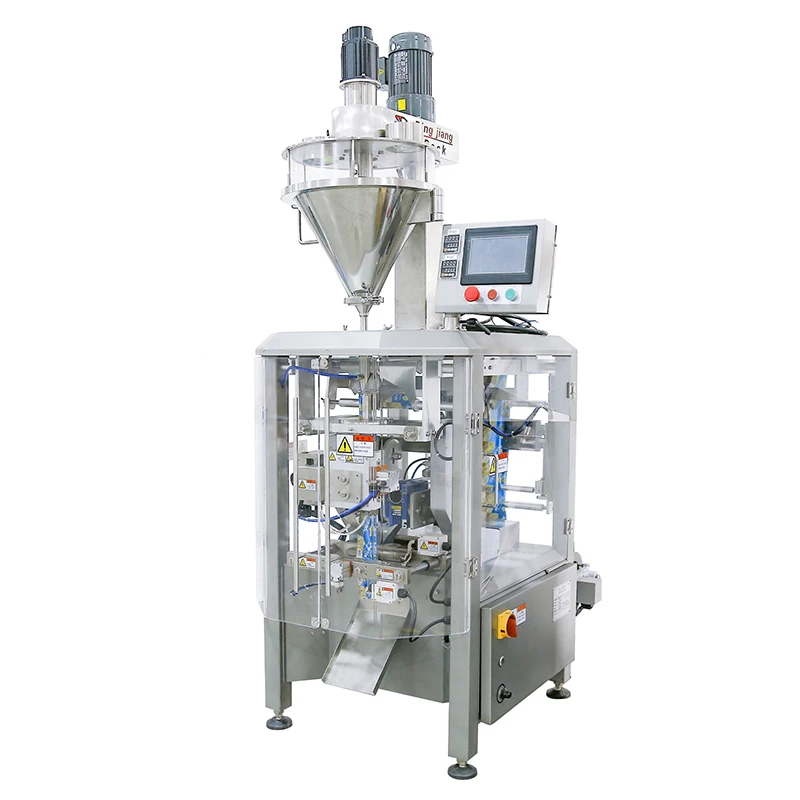
One relevant product is the DJ-240F automatic vertical powder packing machine. It uses screw dosing technology and can be used for products such as milk powder, coffee powder, flour, protein powder, seasoning, soy flour, and certain chemical or pharmaceutical powders.
The machine integrates several packaging operations, including:
Powder dosing
Film forming
Filling
Heat sealing
Cutting
Date coding
The DJ-240F is designed for small powder packages, with a listed filling range of approximately 10–100 g and a production speed that depends on the product, film, filling weight, and machine configuration.
DJ-PACK also supplies larger powder filling systems, including semi-automatic and automatic machines for applications that require bags, containers, or bulk powder packaging. This allows the company to support customers whose packaging requirements extend beyond small sachets.
4. Universal Pack
Universal Pack specializes in single-dose packaging machinery for products such as powders, liquids, creams, and granules.
Its equipment is associated with sachet packaging and multi-lane production systems. Depending on the machine configuration, the equipment can produce sealed sachets for food, pharmaceutical, cosmetic, and chemical applications.
For powder products, the dosing system must be selected according to characteristics such as particle size, density, flowability, and dust generation. Auger dosing and other dosing technologies may be used depending on the product and package format.
Universal Pack is relevant to companies looking for dedicated single-dose packaging equipment rather than general-purpose bagging machinery.
5. PFM Packaging Machinery
PFM Packaging Machinery develops vertical form-fill-seal and other packaging systems for food and industrial products.
PFM equipment can be configured for powdered products using suitable feeding and dosing systems. Typical applications may include flour, sugar, spices, coffee, milk powder, and other dry products.
A powder sachet line from PFM may include a product hopper, feeding system, dosing unit, film forming section, sealing jaws, cutting system, and coding equipment. The exact configuration depends on the desired sachet size, production rate, and product characteristics.
PFM is a potential option for manufacturers that need flexible packaging equipment for different bag formats and product categories.
6. Viking Masek
Viking Masek supplies vertical form-fill-seal packaging machines and related packaging systems.
Its equipment can be used for products such as coffee, spices, powders, granules, snacks, and other dry goods. For powder sachet packaging, the machine generally requires an appropriate powder dosing system, often based on auger technology.
Viking Masek's packaging solutions can be configured for different film structures, bag styles, fill weights, and automation requirements. Depending on the application, the equipment may be used for small bags, sachet-style packages, or other flexible packaging formats.
The company is relevant for businesses seeking a VFFS-based packaging system with powder dosing capabilities.
7. All-Fill
All-Fill is known for filling and packaging equipment, particularly auger fillers and systems for powder products.
Its auger filling technology is used for products such as spices, flour, coffee, pharmaceutical powders, nutritional powders, and other dry materials. The filling equipment can be integrated with packaging machines for bottles, bags, pouches, and sachets.
For powder sachet production, the auger filler is responsible for measuring and dispensing the product. It may be integrated into a vertical packaging machine or another sachet packaging platform.
All-Fill is especially relevant when the dosing system is a major part of the project and the customer needs controlled powder filling rather than only a basic bag-forming machine.

8. Paxiom / WeighPack Systems
Paxiom, including WeighPack Systems, provides automated packaging and filling equipment for food, pharmaceutical, chemical, and other industries.
Its equipment portfolio includes powder filling, pouch packaging, bagging, and complete packaging systems. Depending on the product and package type, powder can be dosed by auger filling or other suitable technologies.
Paxiom's solutions may be considered for companies that need to connect filling, pouch handling, sealing, labeling, and other packaging operations into a more complete production line.
The appropriate equipment depends on whether the customer needs individual sachets, premade pouches, larger bags, or a combination of packaging formats.
9. VTOPS
VTOPS supplies powder filling and packaging machines for food, chemical, pharmaceutical, agricultural, and other dry powder products.
Its product range includes powder auger fillers, semi-automatic filling machines, automatic powder packaging machines, premade pouch systems, and vertical packaging solutions.
VTOPS also offers powder sachet and stick-pack-related equipment. These machines may use screw dosing systems to measure products such as milk powder, coffee powder, flour, spices, cocoa powder, and nutritional powders.
The company's equipment is suitable for businesses looking for different automation levels, from standalone powder fillers to integrated filling and sealing systems.
10. AUGER Enterprise
AUGER Enterprise specializes in auger filling and powder packaging equipment.
Its product range includes semi-automatic auger fillers, automatic powder filling machines, stick-pack machines, premade pouch packing machines, and systems designed to work with VFFS packaging equipment.
AUGER's powder sachet solutions can be used for food, nutritional, seasoning, pharmaceutical, and chemical powders. Its machines may integrate powder dosing, pouch or film handling, sealing, and product discharge in one automated system.
For premade pouch applications, the equipment may include pouch feeding, pouch opening, auger dosing, sealing, and finished pouch discharge. For stick-pack or sachet applications, the packaging format and dosing system must be selected according to the target fill weight and product characteristics.
How to Select a Powder Sachet Packing Machine
Product Characteristics
Powder behavior has a direct effect on machine performance. Free-flowing powders may be easier to dose, while lightweight, dusty, sticky, or poorly flowing powders may require special hopper designs, agitators, screw configurations, or dust-control measures.
Before selecting a machine, the supplier should understand the product's bulk density, moisture content, particle size, flowability, and tendency to absorb moisture.
Sachet Format and Fill Weight
Powder sachets can use different package structures, including three-side seal, four-side seal, stick pack, and multi-lane sachet formats.
The required fill weight also affects the dosing system. A machine designed for 1–5 g sachets may be configured differently from a machine intended for 20–100 g sachets.
The sachet width, length, film material, sealing method, and cutting format should be confirmed before selecting the equipment.
Dosing System
For many powder sachet machines, auger dosing is a common choice because the screw can be configured for different powder characteristics and filling ranges.
However, not every powder behaves in the same way. Some products may require special screw designs, agitation, vacuum conveying, or additional feeding control.
The dosing system should be tested using the actual product rather than selected only from a catalog specification.
Production Speed
Production speed depends on several factors, including:
Sachet size
Fill weight
Number of lanes
Powder flowability
Dosing method
Film characteristics
Sealing time
Operator or feeding limitations
A multi-lane sachet machine can produce several packages per cycle and is often used for high-volume production. A single-lane machine may be more suitable for smaller production volumes or applications requiring greater flexibility.
Dust Control and Sealing Quality
Powder dust can affect sealing quality, machine cleanliness, and the stability of the production process. A suitable powder sachet machine should control product leakage around the sealing area and minimize powder accumulation.
For dusty products, the machine may require dust extraction, suitable feeding design, sealing-area cleaning, and optimized filling timing.
The film must also be compatible with the product and sealing temperature. Poor film selection can cause weak seals, leakage, or package deformation even when the dosing system works correctly.
Testing and Sample Production
Before placing an order, it is advisable to test the actual powder with the proposed dosing and packaging system.
A useful factory test should evaluate:
Filling accuracy
Sachet appearance
Sealing strength
Product leakage
Dust generation
Production speed
Film performance
Long-term operating stability
A machine that performs well with one powder may require adjustments when used with another powder. Product testing is therefore an important part of selecting a reliable sachet packaging solution.
Final Considerations
Powder sachet packing machines vary considerably in terms of package format, dosing technology, production speed, and automation level. Pharmaceutical and high-volume food manufacturers may require multi-lane systems with strict process control, while smaller producers may prefer a simpler machine with flexible fill-weight adjustment.
The most suitable manufacturer should be evaluated according to the powder characteristics, sachet format, target output, filling accuracy, sealing requirements, and future production plans.


